
1. Introduction
The UAE’s Nursing Profession: A Career Worth Pursuing
The United Arab Emirates has emerged as one of the most dynamic and rewarding destinations for nursing professionals worldwide. With its world-class hospitals, tax-free salaries, and a rapidly growing healthcare infrastructure, the UAE continues to attract thousands of skilled nurses from across the globe each year. Nursing is the backbone of any healthcare system, and the UAE is no exception. From bustling urban hospitals in Dubai and Abu Dhabi to specialized clinics and community health centers across all seven emirates, registered nurses are in high demand at every level of care. The UAE government has made significant investments in healthcare expansion — new hospitals, medical cities, and primary health centers are being established at an unprecedented pace, creating a steady stream of opportunities for qualified professionals. Whether you are a Registered Nurse from the Philippines, India, the UK, the USA, or anywhere else in the world, this guide drawn directly from the UAE’s official Unified Healthcare Professional Qualification Requirements (PQR, 3rd Version, 2022) and the DHA’s Computer Based Testing (CBT) Exam Guideline (Updated July 2024) — gives you everything you need to plan your journey.
2. Eligibility Criteria
Educational Qualifications
To qualify for nursing licensure in the UAE, you must meet the following academic standards as outlined in the official PQR:
- Must be a graduate from a nationally and/or internationally recognized nursing college or university.
- UAE university graduates must hold a degree accredited by the Ministry of Education (MOE/NQA).
- Qualifications acquired through honorary, correspondence, or distance-learning programs are not accepted.
- A bachelor’s degree in nursing must be a minimum of three (3) years of full-time study.
- The minimum entry-level qualification for an Assistant Nurse is a nursing diploma of not less than 18 months in duration.
- Nurses must hold a valid Basic Life Support (BLS) certification (or other certifications relevant to their scope of practice).
- Your academic transcript must be submitted for credentialing purposes to determine the disciplines covered.
Experience Requirements

Experience requirements vary depending on the nursing title you are applying for:
| Nursing Title | Minimum Experience |
| Registered Nurse | No experience required* |
| Assistant Nurse | No experience required* |
| School Nurse | 2 years as RN (1 year in pediatrics, ICU, or Emergency) |
| Specialty Nurse (Clinical Master’s) | 1 year post-qualification in specialty |
| Specialty Nurse (Bachelor’s in specialty) | 2 years post-qualification |
| Nurse Practitioner | 2 years post-qualification as Nurse Practitioner |
Subject to Gap of Practice criteria and specific licensing authority requirements.
Special provisions:
- UAE nationals and Children of Emirati Women are exempt from experience requirements.
- Non-UAE nationals who graduated from UAE universities must complete 6 months of clinical training post-graduation in an Approved Practice Setting (APS) health facility (except for Registered Nurse and Assistant Nurse titles).
- GCC nationals are also required to complete 6 months of clinical training post-graduation.
3. Licensing Authorities in the UAE
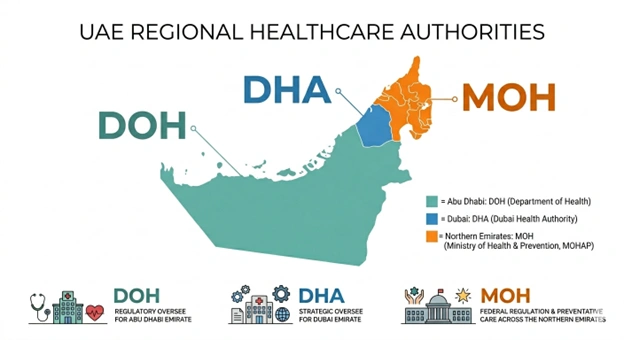
The UAE has three primary health regulatory authorities, each covering specific emirates. Understanding which authority governs your emirate of employment is crucial for your application.
DOH — Department of Health, Abu Dhabi
The DOH regulates all healthcare professionals practicing in the Emirate of Abu Dhabi, including the cities of Abu Dhabi, Al Ain, and Al Dhafra Region. If you are employed in Abu Dhabi — in government or private hospitals, clinics, or health centers — you will need a DOH license. The DOH operates the Sheryan licensing platform for applications and renewals.
Website: doh.gov.ae
DHA — Dubai Health Authority
The DHA regulates healthcare professionals working in the Emirate of Dubai. The DHA is well known for its robust Computer-Based Testing (CBT) system administered through Prometric, with test centers available in over 160 countries worldwide. This means you can sit your DHA exam from your home country before even relocating.
Website: dha.gov.ae | Queries: info@dha.gov.ae
MOH / SHA — Ministry of Health and Other Emirates
The Ministry of Health and Prevention (MOHAP) covers the remaining emirates: Sharjah, Ajman, Umm Al Quwain, Ras Al Khaimah, and Fujairah. The Sharjah Health Authority (SHA) specifically regulates professionals in Sharjah. MOHAP has its own licensing portal and examination system.
SHA Contact: hred@sha.gov.ae | +971 6 5091666
Good news: The PQR is a unified document jointly published by MOHAP, DOH, DHA, and SHA. This means qualification requirements are harmonized across all authorities. Once you hold a valid license from one authority, you may be eligible for licensure recognition with another authority without re-sitting the exam — provided you meet the transfer criteria.
4. Step-by-Step Licensing Process
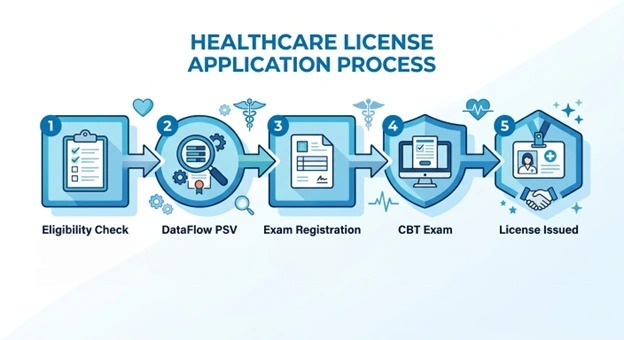
Following this Steps:-
Step 1: Check Your Eligibility
Before anything else, confirm that your qualifications and experience match the requirements for your target nursing title under the official PQR. Use the tables in Section 2 of this guide as a starting reference.
Step 2: DataFlow Primary Source Verification (PSV)
DataFlow is the UAE’s mandatory credential verification service. All non-UAE applicants must complete Primary Source Verification (PSV) through DataFlow before a license can be issued.
PSV verifies your documents directly with the original issuing institutions, including:
- Educational qualifications (degree certificates, transcripts)
- Employment/experience certificates
- Professional licenses and registration from your home country
- Good Standing Certificates (GSC)
Key PSV requirements:
- Your Good Standing Certificate must be valid and not older than 6 months at the time of application.
- The GSC must be issued by the regulatory authority in your country of last employment (or by your employer, if no regulatory body exists).
- You must not have been convicted of any felony or medical malpractice.
Step 3: Exam Registration
After PSV is initiated or completed, apply for registration with your target licensing authority through their online portal. For the DHA, this means the Sheryan platform. You will receive a DHA Unique ID upon registration, which you will use to generate your Eligibility ID for exam scheduling.
The step-by-step DHA process is:
- Check your eligibility
- Apply for registration
- Copy your DHA Unique ID
- Generate an Eligibility ID
- Schedule your exam through Prometric
Step 4: Exam Preparation and Sitting
Schedule your CBT exam through Prometric’s global network of 8,000+ test centers in 160+ countries. You can sit your exam in your home country before relocating.
All examinations are conducted in English. No translators are permitted for oral assessments.
Important exam rules:
- You are granted a maximum of 3 attempts to pass the examination across all authorities.
- You may be granted 1 final attempt with a different authority after failing 3 times with another.
- You must declare the number of exam attempts you have made across all authorities.
Step 5: Application Submission & License Issuance After passing the exam, submit your full license application along with all required documents. Upon successful review, the licensing authority will issue your professional license, which grants you the legal right to practice nursing in the UAE within the specified scope of your title.
5. Exam Details (DHA CBT — Registered Nurse)
Exam Format
| Parameter | Details |
| Exam Type | Computer-Based Testing (CBT) via Prometric |
| Format | Multiple Choice Questions (MCQs) |
| Duration | 3 Hours (including registration and introduction) |
| Number of Questions | 150 questions |
| Exam Code | RNT0312 (Registered Nurse) / ARN5061 (Assistant Nurse) |
| Pass Score | 50% (Registered Nurse) / 45% (Assistant Nurse) |
| Fee | USD 240 |
| Result | Pass/Fail (shown in Sheryan account; individual score not shared) |
Syllabus Breakdown — Registered Nurse
The DHA CBT for Registered Nurses covers four core domains:
- Unit Management & Leadership — nursing management principles, delegation, supervision, and leadership in clinical settings.
- Fundamentals of Nursing — core nursing concepts, patient assessment, health history, vital signs, infection control, medication administration, and basic life support.
- Maternal-Child Nursing — obstetric nursing, newborn care, pediatric nursing, child development, and neonatal care.
Adult Nursing — medical-surgical nursing, critical care, mental health nursing, community health nursing, and pharmacology.
Recommended Study Materials
The following references are officially listed by the DHA:
- Berman & Snyder — Kozier and Erb’s Fundamentals of Nursing Concepts, Process and Practice (Latest Edition)
- Brunner and Suddarth — Canadian Textbook of Medical-Surgical Nursing (Latest Edition)
- Wong, D.L. and Hockenberry, M.J. — Wong’s Nursing Care of Infants and Children (Latest Edition)
- Sole, Klein & Moseley — Introduction to Critical Care Nursing (Latest Edition)
- Townsend, C.M. — Essentials of Psychiatric Mental Health Nursing (Latest Edition)
- Allender & Rector — Community Health Nursing: Promoting and Protecting the Public Health (Latest Edition)
- ANA Code of Ethics (Latest Edition)
- McKenry, Tessier & Hogan — Mosby’s Pharmacology in Nursing (Latest Edition)
- Murray & McKinney — Foundation of Maternal-Newborn Nursing (Latest Edition)
Exam Exemptions
You may be exempt from the licensure exam if you hold a valid license and Good Standing Certificate issued by one of the following countries — provided your qualification was obtained within the last 2 years OR you have had no gap in practice since your last day of employment:
Austria, Australia, Belgium, Canada, Denmark, Finland, France, Germany, Iceland, Ireland, Luxembourg, Netherlands, New Zealand, Norway, Singapore, South Africa, Sweden, Switzerland, United Kingdom, and United States of America.
English Proficiency Requirement: If your nursing license is from a non-English speaking country in the above list, or your university studies were not conducted in English, you must provide one of the following:
- TOEFL score of at least 500
- IELTS score of at least 5.0
- OET (Occupational English Test) of at least Grade C
- Cambridge Assessment English score of at least 169
6. Fees Structure
Below is an approximate breakdown of the costs involved. Note that fees are subject to change; always verify current rates on the official authority websites.
| Fee Category | Approximate Amount |
| DataFlow PSV (Primary Source Verification) | USD 140 – 200 (varies by documents and country) |
| DHA CBT Exam Fee (Registered Nurse) | USD 240 |
| DHA CBT Exam Fee (Assistant Nurse) | USD 240 |
| License Application/Issuance Fee | AED 300 – 500 (varies by authority) |
| License Renewal (Annual CME requirement) | AED 200 – 500 + CME credit costs |
| Approximate Total | USD 600 – 900 (not including travel or re-examination fees) |
CME Requirements for License Renewal: Nurses must complete a minimum of 20 CME/CPD credits per year, relevant to their specialty, to maintain their UAE license.Gap of Practice Note: If you have been out of clinical practice for 2 to less than 3 years, you will need 20 CME/CPD credits and 4 months of supervised training before you can apply for a UAE license.
7. Job Opportunities & Scope in the UAE
Where Nurses Work

UAE-licensed nurses are employed across a wide range of healthcare settings:
- Government hospitals (e.g., Cleveland Clinic Abu Dhabi, Sheikh Khalifa Medical City, Rashid Hospital, Dubai Hospital)
- Private hospital networks (e.g., Mediclinic, NMC Healthcare, Aster, LLH, Burjeel, Al Zahra)
- Specialty clinics — oncology, cardiology, orthopedics, fertility, and rehabilitation centers
- Community health centers and primary care clinics
- School nursing — with relevant pediatric experience and PALS certification
- Home care agencies
- Occupational health units in corporate settings
Specialty Nurse Titles Recognized in the UAE
The PQR recognizes the following nursing specialties for licensure:
Certified Anesthesia Nurse, Community Nurse, Pediatric Nurse, Mental Health Nurse, Critical Care Nurse, Neonatal Nurse, Home Care Nurse, Infection Control Nurse, Emergency Nurse, Oncology Nurse, and Dialysis Nurse.
Salary Expectations
Nursing salaries in the UAE are highly competitive and tax-free. Approximate monthly ranges:
| Nursing Level | Monthly Salary (AED) | Approx. USD |
| Assistant Nurse | 3,500 – 6,000 | USD 950 – 1,650 |
| Registered Nurse | 6,000 – 12,000 | USD 1,650 – 3,270 |
| Senior/Specialty Nurse | 10,000 – 18,000 | USD 2,720 – 4,900 |
| Nurse Practitioner | 15,000 – 25,000 | USD 4,080 – 6,800 |
Many employers also provide housing allowance, annual flight tickets, medical insurance, and end-of-service gratuity, which substantially increases the overall compensation package.
Career Growth Opportunities
The UAE healthcare sector offers meaningful pathways for career advancement:
- Progress from Registered Nurse → Specialty Nurse → Nurse Practitioner
- Move into leadership roles: Charge Nurse, Head Nurse, Nursing Supervisor, Director of Nursing
- Pursue further education at UAE universities (many offer part-time MSc nursing programs)
- Transition into healthcare education, clinical training, or quality and accreditation roles
- Explore opportunities with the DOH, DHA, or MOHAP in regulatory and policy roles
8. Tips for Success

Exam Preparation Tips
- Start early. The DHA CBT covers four broad domains, and 150 MCQs in 3 hours requires both knowledge and speed. Give yourself a minimum of 3–4 months of dedicated preparation.
- Use the official references. Study from the books listed in the DHA’s official exam guideline. Prioritize the latest editions of Kozier and Erb’s Fundamentals of Nursing, Brunner and Suddarth’s Medical-Surgical Nursing, and Wong’s Nursing Care of Infants and Children.
- Practice with MCQ banks. Platforms like UWorld, Lippincott Q&A, or DHA-specific nursing question banks help you adapt to the MCQ format and identify weak areas.
- Focus on high-yield areas. Adult nursing and fundamentals carry significant weight. Pay special attention to medication administration, infection control, patient safety, ethics, and critical care basics.
- Time yourself. Practice answering 150 questions in 3 hours. That’s roughly 72 seconds per question — time management is as important as clinical knowledge.
- Review UAE healthcare ethics. Questions on professionalism and patient safety appear in virtually every UAE licensing exam. Familiarize yourself with the ANA Code of Ethics and UAE healthcare law basics.
Common Mistakes to Avoid
- Ignoring the Gap of Practice rules. If you have not practiced clinically for more than 2 years, you must complete CME and supervised training before applying. Many applicants are surprised by this requirement.
- Submitting an expired Good Standing Certificate. Your GSC must be valid (not older than 6 months) at the time of application — not at the time it was issued.
- Underestimating DataFlow timelines. PSV can take 4–10 weeks depending on your country of origin. Start this process as early as possible.
- Not declaring previous exam attempts. You are legally required to declare the number of exam attempts across all UAE authorities. Misrepresentation is a serious violation.
- Choosing the wrong authority. Make sure you know which emirate you will be working in before you apply, as your license is authority-specific.
- Using distance-learning or correspondence qualifications. These are explicitly excluded from the PQR and will not be accepted regardless of the issuing institution.
9. Conclusion

The UAE healthcare sector is one of the most dynamic, well-compensated, and professionally rewarding environments for nurses in the world. With a unified qualification framework governed by internationally benchmarked standards, the path to UAE licensure — while thorough — is clear and achievable for any qualified nursing professional.
Whether you are a newly graduated nurse from a recognized university or an experienced specialist looking for your next chapter, the UAE offers a vibrant ecosystem where your skills are valued, your career can flourish, and your financial future is bright.
The journey begins with a single step: checking your eligibility. From there, every milestone — DataFlow verification, exam registration, your Prometric test date, and finally, the moment your license appears in the Sheryan portal — brings you closer to a career that could truly transform your life.
Start your journey today. Gather your documents, review the qualification requirements, and take the first step toward practicing in one of the world’s most progressive healthcare systems.